
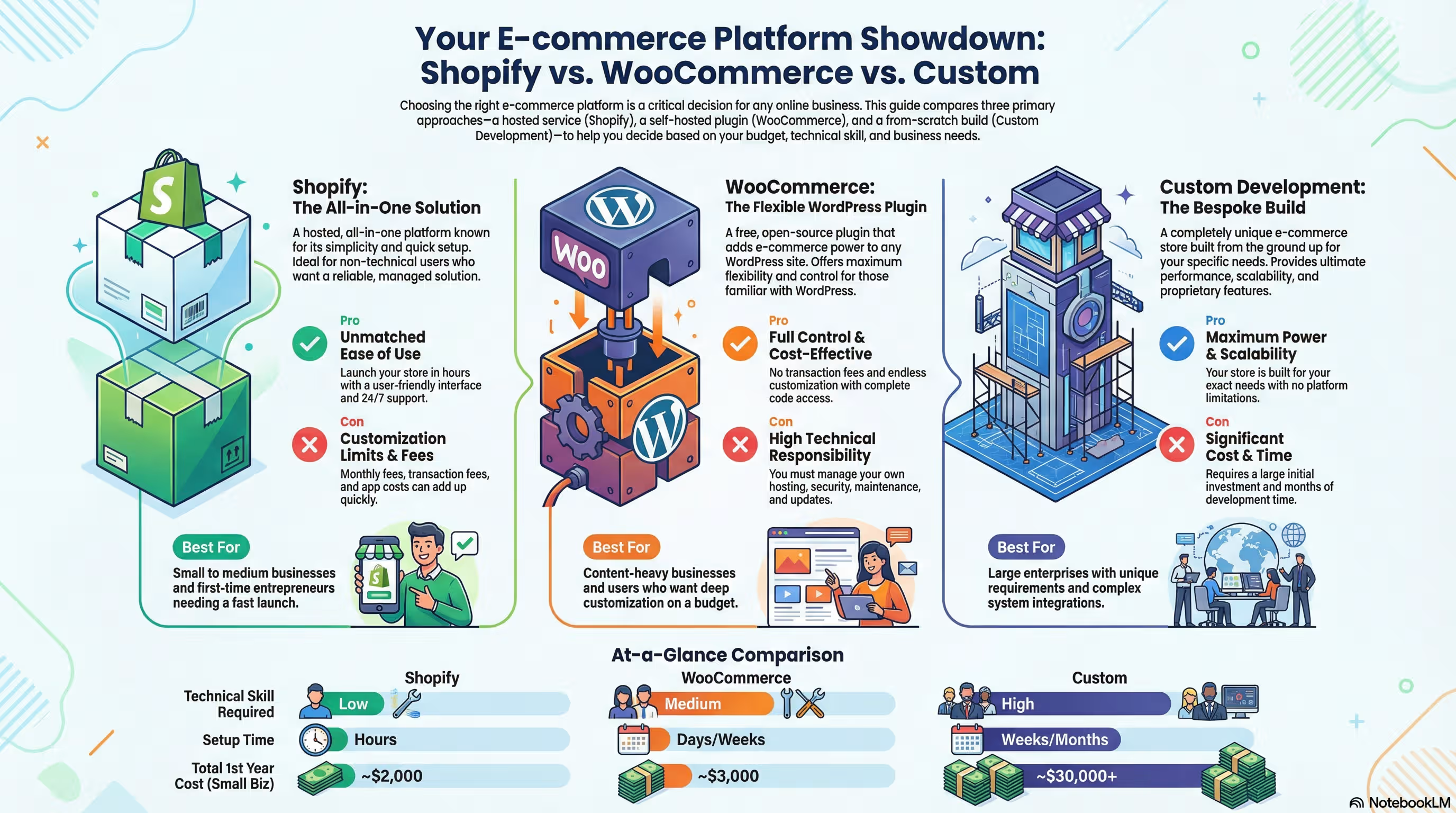
E-commerce Platform Comparison 2026: Shopify, WooCommerce or Custom?
Written by
Shaurya Verma
Writer and proofreader
Writing, content audits and proofreading across much of the OctaVertex Media website.
Key takeaway
Compare commerce platforms by catalogue, checkout, integrations and maintenance responsibility. A practical 2026 decision checklist without invented ownership costs.
Compare the buying journey before comparing platforms
Start with the products you sell, how customers choose them and how staff fulfil a paid order. A standard catalogue, a wholesale quote process and a subscription business do not necessarily need the same storefront. The useful question is which platform covers your required workflow with manageable ongoing work.
This October 2026 update removes unsupported market-share statistics and three-year price projections. Request current provider pricing for your country, billing arrangement and payment method when preparing a budget.
Questions for each option
| Option | Establish before choosing |
|---|---|
| Shopify | Which requirements fit the selected plan and apps, which need custom integration, and who maintains those connections |
| WooCommerce | Who owns hosting, updates, extensions, backups and compatibility checks in the proposed WordPress setup |
| Custom storefront | Which requirement justifies custom engineering, what commerce backend it uses, and who maintains checkout and integrations |
A custom frontend is not the same as building every commerce function yourself. Ask the supplier to draw the boundary between the storefront, catalogue, checkout, payments and order-management systems. Avoid paying for a custom layer simply because it looks different in a demo.
A specific 2026 maintenance consideration
Shopify's API versioning documentation identifies 2026-10 as the latest stable version at this review date. Shopify publishes versioned API releases quarterly and supports stable versions for at least 12 months. That means a custom integration needs a named maintenance owner and an upgrade plan; connecting it once is not the end of the work.
This does not mean every store needs a new integration or a migration now. Ask which APIs the proposed solution uses, their version and the work needed when a dependency changes.
Compare total responsibilities as well as cost
Request separate estimates for the initial build, catalogue preparation, migration, subscriptions, payment-provider charges and support. Ask how pricing changes with additional markets, apps or unusual order rules. Avoid a fixed multi-year total without explicit assumptions about usage and ongoing work.
For an existing store, inspect where the problem occurs before selecting a rebuild: product discovery, cart, payment or fulfilment. Traffic quality, product pricing and demand can also affect sales. A new platform alone does not guarantee an improvement.
Use a relevant project to define your brief
SuratBazaar's case study describes variants, cart, authenticated checkout, payments and order operations. It is useful when scoping a direct-to-consumer buying journey. Packmold instead documents a quote-first catalogue. The distinction matters more than choosing a platform before defining the sale.
Bring your current store URL, product and variant counts, required providers and the most difficult operational step. Explore our e-commerce development service, or discuss your store.
The platform information above was checked on 11 October 2026. Exact plan entitlements and provider charges should be checked when the proposal is prepared.
Talk to the studio
AI-enabled platforms, growth, and product work for founders—India delivery, global clients.